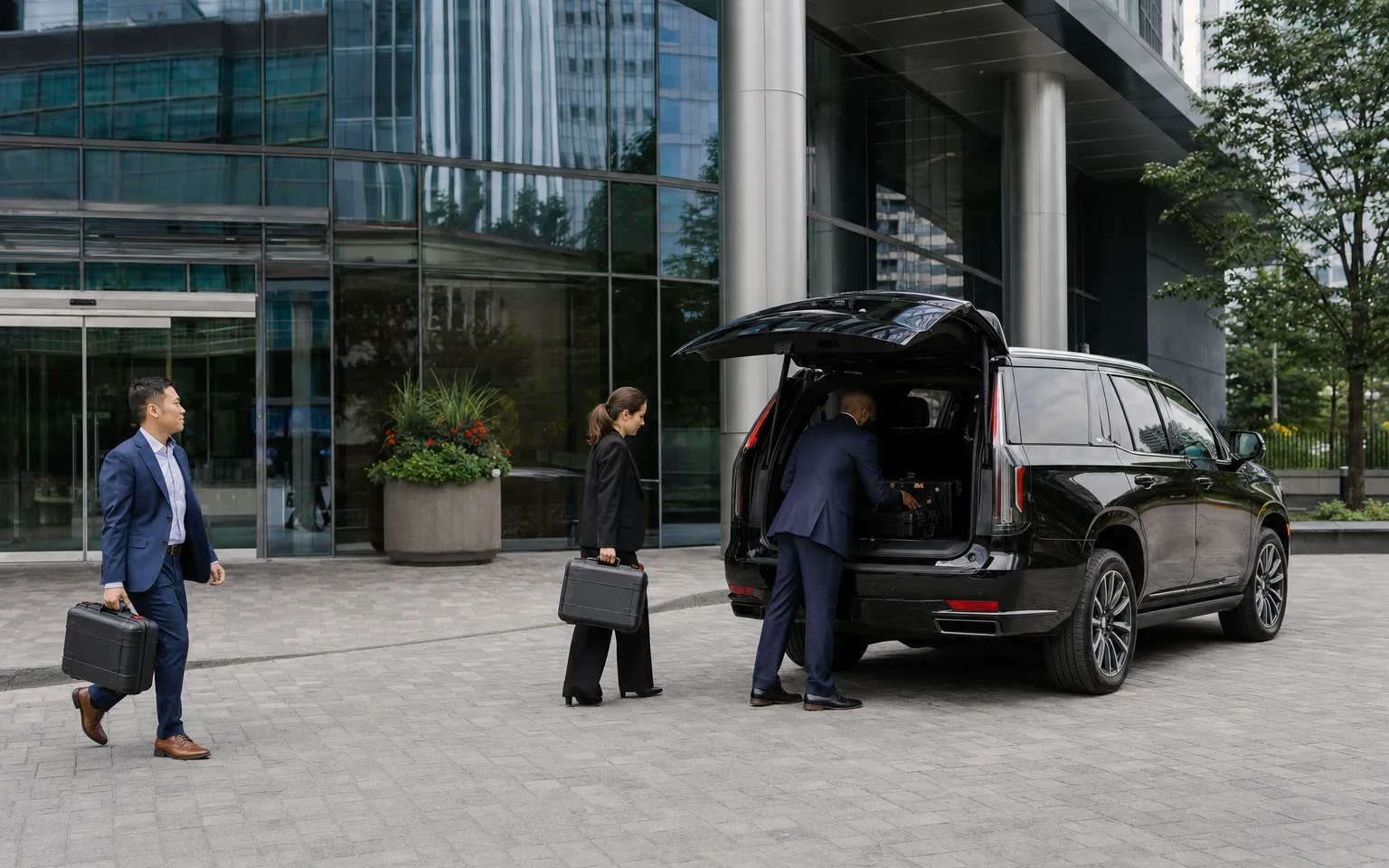
A corporate roadshow rewards precision. A team visiting four client sites in Toronto and the surrounding region cannot afford a late vehicle or a wrong turn. Good transportation planning takes some of that pressure away, and most of it can be done in one sitting.
What makes a roadshow different from a regular transfer?
A transfer is one pickup and one drop-off. A roadshow is a chain of them, with fixed arrival times, dependent timings and a team that works while it travels. The vehicle becomes a moving meeting room, so comfort, legroom and the ability to leave bags safely matter more. It also means the schedule is the booking: each stop and each waiting period is part of what we quote.
What should the itinerary include?
Write it as a table, one row per stop. For each stop give the address, the time you need to arrive and how long you will stay.
| Item | Why it matters |
|---|---|
| Arrival time at each stop | Sets the driving schedule |
| Time on site | Defines waiting time |
| Next destination | Lets us plan the route |
| Contact on site | Helps if access is unclear |
| Return time | Fixes the finish of the day |
Add buffer around the downtown core and busy highways. A schedule with no slack punishes everyone the moment traffic slows.
Which vehicle matches the team?
| Team | Vehicle | Notes |
|---|---|---|
| 1 to 3 executives | Executive sedan | Quiet and efficient |
| Up to 6 with cases | Luxury SUV | Extra room for equipment |
| 8 to 10 | Stretch limousine | Seating that faces other passengers |
| Larger groups | Group coach | Quote only |
Seating and bag space are pinned down in the written quote. For bigger events, see corporate event transportation.
How do you manage multiple stops and waiting?
Waiting time is often the biggest part of a roadshow quote, so be realistic. If a meeting might run over, say so and give a range. If the team will be inside a building for hours, ask whether it makes more sense for the vehicle to leave and return. Another option is to plan a single long booking with the vehicle on standby. We discuss the trade-offs and quote the version you choose.
What can go wrong, and how do you avoid it?
Roadshows fail in small ways. A client site has a gated entrance the driver does not know. A meeting runs forty minutes over. A colleague arrives at the wrong terminal. You can head off most of this with preparation:
- Share on-site contact names and entrance instructions in advance.
- Build in a gap between meetings rather than scheduling them back to back.
- Decide ahead of time what happens if a meeting runs long: does the next one move, or does the team travel on?
- Confirm the final drop-off, which is often a hotel or the airport rather than where the day began.
- Keep a printed or saved copy of the itinerary so everyone can see it.
None of this is complicated, but writing it down once saves a dozen phone calls on the day.
Who should coordinate on the day?
Pick one person from the team. Give the driver that person’s mobile number, and ask the team to direct changes through them. It prevents a driver from taking conflicting instructions. For visiting colleagues flying in, add the airport limo service to the plan so arrivals and the roadshow share one point of contact.
How do you request a quote?
Paste the itinerary table into a message along with dates, headcount, equipment and the starting address. Total hours and standby periods drive the quote more than distance does, and the reply is a single written figure. The quote form takes all of it. If you are planning wider group travel, how to plan group transportation offers a general checklist.